
US Wheat Exports
- Tuesday Oct 31, 2006
This analysis featured in the October 31, 2006 issue of the HGCA's MI Prospects, Volume 9, Number 9
Key points
- Uncertainty about wheat price development over the season
- US wheat exports to be watched as an indicator of the state of the wheat market
- US wheat exports estimated at 25.2Mt by USDA for 2006/07 (27.5Mt in 2005/06)
- Up to 12 October this season, US wheat exports below average levels
- Since 1972, detailed weekly reports on US grain exports
The US wheat price outlook, although very favourable, is less certain than normal at this time of year. If lagging US wheat exports pick up, as anticipated, further increases in prices are probable. If they don't, prices can be expected to sag.
With the southern hemisphere wheat crops sown and within a few months of harvest in Australia and Argentina, the remaining components of world wheat production forecasts have become more certain for 2006/07. Projections for Australian output have been substantially cut in recent months, reducing forecasts for world stocks-to-use ratio, an indicator of the tightness of the supply and demand balance, to the lowest ever recorded (Table 1).
continue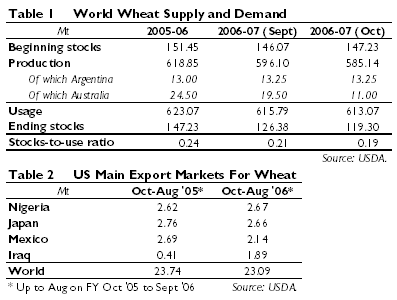 continued
While global production and crop availability estimates are finalized, price prospects over the winter remain uncertain. Indeed, as prices have not been so high for many years, no recent experience can be used as a reference to predict the market direction. However, price levels will ultimately be determined by both the effectiveness of price incentives in drawing marketable grain out of inaccessible places - a supply side factor, and the reaction of consumers to much higher prices than they have been used to in recent years - a demand side factor.
Indicator of the Market State
To have a clearer vision of the evolution of the market, data regarding demand should be more reliable. Indeed, as production is the most variable element in the supply/demand balance, it receives the most attention in terms of surveys and estimates, while consumption is often calculated as a residual. Further, wheat stocks in importing countries (where ending stocks are increasingly concentrated) are more widely dispersed than those in exporting countries. And in some cases concern exists as to the quality of the grain.
The best available barometer of world grain consumption trends is almost certainly US export data. In the case of wheat, US exports account for 20% to 30% of world trade and 30% to 40% of US supply. More critically, it is published promptly, on a weekly basis, for both sales commitments and physical movements and in considerable detail. This year, because of the uncertainty of the demand side of the balance, US trade data will receive particular attention as an indicator of demand.
The USDA currently forecasts US wheat exports at 25.2Mt, 8.4% less than last year. This drop reflects reduced US supply as a drought has hit the production of hard red winter and spring wheats, the two major high-quality export classes. The increase in production of soft red and white winter wheats has not been sufficient to offset reduced supplies of hard red wheats. Moreover, the forecast ending stocks, at 11.4Mt, would be lowest since the Soviets cleared out US wheat supplies in the mid 1970's.
However, US export projections may not be met. Weekly reports of cumulative export sales (sales commitments, indicator of future physical exports) and inspections of wheat for export (physical movements) in mid-October, which is about 20 weeks into the US crop year, indicate that demand for US wheat is lagging forecasts. Indeed, to October 12, net export commitments totalled 11.7Mt while inspections were at 8.3Mt, 19.5% and 16% below last year respectively. In terms of percentage of the estimated exports for the whole crop year, both physical exports and export sales commitments matched last year’s and the five-year average rate early in the crop year (Graphs 1, 2). However, this year’s figures slipped and it seems that the gap between this year's and last year's or the five-year average rate has been widening. By 12 October, physical exports were at 32.8% compared to 38.8% and 39.5%, respectively, for last year and the five-year average and exports sales were at 46.3% compared to 55.3% and 55.6%.
continue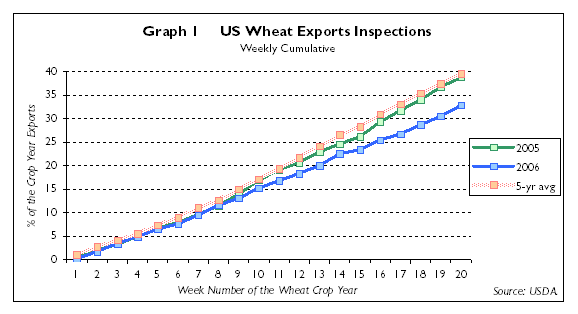 continued
continue
continued
continue continued
Interestingly, the USDA raised forecast exports for 2006/07 this month on the basis of reduced export availability of Australian wheat. In its monthly Wheat Outlook, it suggested that 'the pace of early season sales and shipments has been relatively slow but is expected to be stronger than usual in the later months of the year as exportable supplies in other countries are depleted'.
The US grain trade is concerned that US wheat is pricing itself out of the market. But statistics indicate that wheat importers have few alternatives to US wheat. If, and when, the rate of US export sales increases, so will prices.
Nevertheless, it is possible that higher prices will reduce consumption; and/or wheat will be readily available from supposedly inaccessible sources (Central European intervention stocks, China, improved logistics in traditional exporting countries); and/or many importers have larger stocks than recorded in the statistics. If the rate of sales continues to lag, prices will start to decline.
US Grain and Oilseed Trade Reporting
Since 1972, the US has had a very detailed and timely system for reporting of grain and oilseed exports. This was the year when the Soviet Union, while increasing food consumption, suffered a serious drought and was compelled to import unprecedented quantities of grain, initially from the US which was granting export subsidies. But the magnitude of the Soviet business only became known weeks later. To ensure this did not happen again, the US instituted a programme for reporting export sales of grains, oilseeds and some other farm commodities. As a consequence, both export sales and physical export grain are reported and published in detail by the USDA, respectively on Thursdays and Mondays for the week ending the previous Thursday. Moreover, sales of more than 100,000t have to be reported the next day.
Finally, in addition to the forecasts published by the USDA, US customs also collect US trade data which is then compiled and published on a monthly basis by the US Department of Commerce, including both physical volume and value of trade.
David Walker 001 780 434 7615
top of page